

In partnership with

It was 09:07 AM on a Tuesday when my phone violently vibrated. I picked it up, expecting an urgent email from a colleague or perhaps a text from my mother.
Instead, it was a message in a WhatsApp group titled: “Emma’s Surprise Bday 🎈🥂”
The party had occurred four years ago. The surprise had been ruined. Emma and her boyfriend had since broken up, moved to different continents, and adopted separate dogs. The chat had been a dormant, digital graveyard for 48 months.
Suddenly, the screen illuminated with an image, followed by Peter's message: “Actually, we could have made a poster of this for Emma.”

I searched for any information about this masterpiece, and the only detail I found was that it was painted on a wooden panel from Mathieu Mieg's house in Mulhouse, France.
Yes, Peter, we could have. And honestly, that’s the kind of art I might even hang in my home. I even believe you and I could share an appreciation for disproportionate art and discuss it under different circumstances, but what made you think that rat-cat hybrid would have been a better gift after four years? And what made you think we should feel remorse for our previous choice now?
Yet I just stared at the screen in horror, not because of my surprise at such a precise and very realistic depiction of a cat, but because I realised that if I had to read a 4-year-late gift idea, it meant I was trapped in digital purgatory.
I desperately wanted to leave the chat. But I couldn't. Because the painting captured my attention and because if I pressed that red button, WhatsApp wouldn't just quietly remove me. It would generate a highly visible, grey, centred system message for all 18 participants to see:
Asena left the group.
Jean-Jacques Rousseau and the Chains of WhatsApp
Why does leaving a dormant, useless group chat feel like a profound ethical betrayal?
To understand the paralysing fear of the "Leave Group" button, we must look to the 18th-century philosopher Jean-Jacques Rousseau and his foundational text, The Social Contract. Rousseau famously wrote: "Man is born free, and everywhere he is in chains."
When you are added to a group chat, you are forcefully entered into a digital Social Contract. You surrender your natural state of peace and notification-free solitude in exchange for the collective goal of society (in this case, splitting the cost of a Zara gift card for Emma).
But the party ended. The contract was fulfilled. Yet, the chains remain. The problem with the modern digital ecosystem is that it has eradicated the "natural drift." In the physical world, when a party is over, you do not have to stand in the centre of the living room with a megaphone and announce, "I AM NOW TERMINATING MY INVOLVEMENT WITH THIS GATHERING." You just slowly approach the door, grab your coat, and perform an Irish Goodbye.
…my independent character has always made it impossible for me to submit to the constraints which must be accepted by anyone who wishes to live among men. As long as I act freely I am good and do nothing but good, but as soon as I feel the yoke of necessity or human society I become rebellious, or rather recalcitrant, and then I am of no account.
When I ought to do the opposite of what I want, nothing will make me do it, but neither do I do what I want, because I am too weak. I abstain from acting, because my weakness is all in the domain of action, my strength is all negative, my sins are all sins of omission, rarely sins of commission. I have never believed that man’s freedom consists in doing what he wants, but rather in never doing what he does not want to do, and this is the freedom I have always sought after and often achieved, the freedom by virtue of which I have most scandalised my contemporaries
But technology refuses to let us fade away. The algorithm functions as a strict, moral panopticon. The system notification—Asena left the group—is a digital guillotine. It forces everyone to perceive your exit not as a natural, organic drifting apart, but as a violent, aggressive act of rejection. It says to Peter, “Your 4-year-late present offer was so fundamentally repulsive that Asena has chosen digital exile over sharing a server with you.”
So, instead of leaving, we mute. We archive. We drag the chat into the digital basement and pretend it doesn't exist, living in perpetual, coward-induced servitude to a party that happened in 2022.
Partner Spotlight
Feeling off lately? It could be your hormones.

3pm crashes every day. Unexpected weight gain. Unpredictable cycles. When symptoms start piling up, your hormones and metabolic health are often part of the story.
Allara helps women understand what's really going on with comprehensive hormone and metabolic testing. Their advanced testing goes beyond the basics to measure key markers like insulin, thyroid function, reproductive hormones, and metabolic health. Whether you already have a diagnosis or are still searching for answers, Allara's care team uses your results to create a personalized treatment plan with expert medical and nutrition guidance.
They treat a wide range of women’s health conditions, including PCOS, fertility challenges, weight management, perimenopause, thyroid conditions, and more.
With Allara, you get clarity, expert support, and a personalized care plan all for as little as $0 with insurance. This isn’t about quick fixes. It’s about understanding your body and addressing the root causes.
The Cat and the Unbearable Lightness of Leaving
If I am a coward bound by the heavy, ethical duties of the Social Contract, the cat is a sovereign citizen acting wholly outside the limits of human morality.
The cat has never felt guilty about leaving a room. She does not understand the concept of lingering social obligation. Last night, she entered the living room, jumped onto the sofa beside me, and demanded to be petted. She purred. We shared a lovely, intimate moment of cross-species connection.
Then, exactly 45 seconds later, she simply stopped purring. She stood up, did not look at me, and did not issue a warning. She just hopped off the sofa and walked out of the living room, her tail held high in the air, a clear sign of complete indifference.
There was no transition. She didn’t say, "Sorry, I have to go check my food bowl." She didn't concern herself with my feelings of rejection. She simply took what she needed from our interaction, and once the moment’s usefulness was over, she ended the contract.
She is the undisputed master of the physical Irish Goodbye. To her, existence is fluid. You are either in the room or out of it. The idea of sitting on the sofa for three extra years just to avoid hurting my feelings is such a pathetic concept that she wouldn't even bother to yawn at it.
Embracing the Grey Text
I looked at the cat, sleeping peacefully in the hallway, completely unbothered by the trail of abandoned social interactions she leaves in her wake.
I glanced at my phone again. The cat-rat remained, glaring at me. I considered threatening my cat with, 'If you act against social obligations, I'll have you painted like that and hang it on this wall,' but I soon realised she wouldn’t care.
We cannot live our lives in the digital basement. We cannot allow our phones to hold us hostage with the threat of a grey timestamp. Sometimes, to reclaim our natural freedom, we must be willing to become the villain in Peter’s narrative.
I took a deep breath. I channelled the unapologetic, ruthless sovereignty of the feline spirit. I tapped the chat settings. I scrolled to the bottom. I closed my eyes, and I pressed "Leave Group."
The chain snapped. The notification was deployed. I was free.
See you next time. Press the button,

Asena
RABBIT HOLE
Every week, I fall down a few rabbit holes. I gather here some insightful things (I don’t promise) I have read, watched, and discovered over the last seven days. If you’re looking for a bit of wonder, click the links below to explore more.
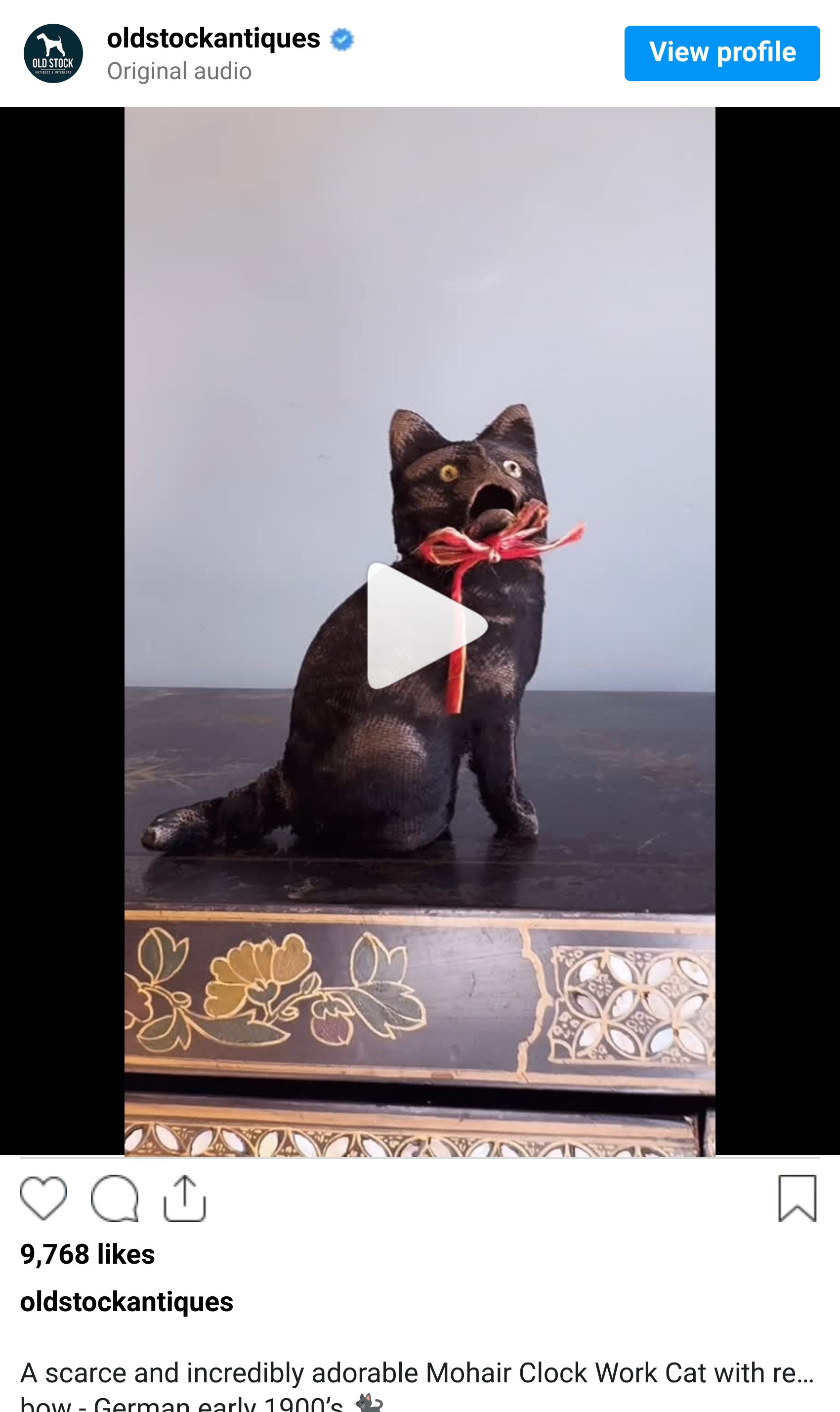
I saw the other day that "vintage charm" is often just a polite way of saying "haunted," and this little guy is the poster child.

According to the description, this is a German Mohair Clockwork Cat from the early 1900s. He’s scarce, he’s adorable, and he’s clearly seen things during the turn of the century that would make a modern tabby cat faint.
It's like your grandmother’s favourite pet, but it’s been caffeinated and given a tiny, mechanical soul. It doesn't just "move", it moves violently. We’re talking a full-body rhythmic possession where the head swivels, the mouth snaps at the air, and the tail lashes out.
I am thinking of asking for the price of this perfectly functional, incredibly rare, and guaranteed to be the most talked-about (and slightly feared) item on my shelf.
Caution: Watching the video may raise concerns, as this isn't quite a "playful frolic".
Many people believe poetry is only about dusty old men mourning Greek urns, but I am sure it can be corrected by Bette Westera’s "Zo voelt dat" (That’s How It Feels). I read children's books and anything rated 3+, and I consider myself part of the plus category, as it doesn’t specify an upper limit.
I enjoyed the poetry in his book, which explores everyday things. Have you ever felt like a waterfall that doesn't know where it's heading, or like a piece of furniture that just wants to be sat on? This book has a poem for that.
Because sometimes, you just need a poem to tell you that being "a little tatty" (just like our clockwork cat) actually adds to the charm.

Here is my poor translation:
The Waterfall
I come streaming loudly down the rocks in a rush.
My droplets sparkle, breaking the rays of the sun.
I am what you see right now - not the river, not the source.
Not what just flowed away, not what is yet to run.
A waterfall exists only in the here and now.
Enjoy every single drop, with or without an umbrella.
In my parents' garden's fragile ecosystem, a regime change has occurred. The cat invasion reduced the lizard population, clearing the way for a terrifying Renaissance of spiders. I reached for a piece of fruit, only to find a black-bodied, red-eyed beast glaring at me with a look that said, 'Keep walking, pal, if you want to keep the finger.' I moved to prune a flower when a neon-coloured one practically shouted, 'Oi! You got a licence for those shears, mate?' Now, as I sit here researching which spiders are 'friendly neighbours' and which are 'instant death', with David Attenborough’s voice in the background, I bumped into this painting.

Tsuchigumo is killed by Minamoto no Yorimitsu
This painting depicts the legendary climax of the battle between the 10th-century hero Minamoto no Yorimitsu and the Tsuchigumo, a monstrous "Earth Spider" from Japanese folklore.
The myth describes how the spider-demon attempted to assassinate Yorimitsu while he was bedridden with a mysterious fever. However, the warrior ultimately tracked the injured creature back to its mountain lair and killed it along with its smaller minions, as shown in the scene.
Although the artwork depicts a high-fantasy battle against a supernatural yōkai with a human-like face, the term "Tsuchigumo" historically had a darker political connotation. It was a derogatory label used by the imperial court for native clans that resisted submitting to central authority.
This illustration, typical of Japanese handscrolls and woodblock prints, serves as a classic example of how history and horror were blended to cement Raikō’s status as a legendary protector of the realm.
That’s it. You’ve now officially reached the bottom. Thank you for reading. ❤️ Your reward this week is this rare carved pumpkin that looks like both the protagonist of a children's book and a witness to a crime it wasn't meant to see.

If this email has been forwarded to you, blame your friend. Then join here →